Saturday, April 16, 2011


I, Robot by Issac Asimov is a short story anthology that tells the stories of robots in a future where they are common household items. I, Robot was published in 1950 and it revolutionized the science fiction genre. I, Robot is one of few science fiction novels that has had a major impact on popular culture Before I, Robot people were not very interested in robots as a subject of literature because they were bland, authors were not sure how to treat their intelligence or their obedience to humans. Asimov changed this with the introduction what he called The Three Laws of Robotics. Asimov’s three laws are as follows

1. A robot may not injure a human being or, through inaction, allow a human being to come to harm.

2. A robot must obey orders given it by human beings except where such orders would conflict with the First Law

3. A robot must protect its own existence as long as such protection does not conflict with the First or Second Law

Through the use of these three laws governing the robots in his fiction Asimov was able to make the subject of Robots interesting to the public and they remain a staple of popular culture to this day (Transformers anyone?).

The first story is entitled Robbie. This story is about a robot named, you guessed it, Robbie and how he affects the life of the child he takes care of, a girl named Gloria. Gloria’s mother bought Robbie when it was “cool” to own a robot servant. Gloria and Robbie become very good friends. Gloria spends more time with Robbie then she does with any other people. However, when it becomes “uncool” to own a robot Gloria’s mother sends Robbie back to the factory that he came from. Gloria then descends into a deep depression. Gloria’s mom tries everything she can think of to try and get Gloria to let Robbie go but it doesn’t work. As a last resort Gloria’s mom decides that Gloria needs to be in a different place to forget. It doesn’t work and this is when her dad has a thought. He says that Gloria needs to stop thinking of Robbie as a person and think of him as a machine and then she will get better. They decide to go to the robot factory. Robbie is at the factory and Gloria runs to him, in the process almost getting run over by a forklift. Robbie saves her life. It turns out the father planned Gloria’s reunion with Robbie of this. Gloria’s mom finally admits that Robbie might not be a monster like society has made robots out to be.

1. Do you think discrimination against an artificial intelligence, Robbie, could be looked at in the same way as racism is today?

The second story is entitled Runaround as deals with a paradox created by the juxtaposition of the Second and Third law. A robot named Speedy and a scientist are sent to Mercury to repair a mining station that has run out of selenium fuel. Once on Mercury the scientist sends Speedy to go get selenium out of a nearby selenium pool. After several hours the scientist becomes concerned and goes out to investigate. It turns out that Speedy is caught in a feedback loop between the Second Law (obey human orders) and the Third Law (protect it’s own existence). It is having this conflict because the scientist never emphasized the importance of this order to get the selenium and therefore the Second Law is not over ruling the Third Law. Eventually the scientists puts himself in danger so the First Law will over rule the other two laws and end the feedback loop. His plan works and they accomplish the mission.

2. What do you think about this situation? Can you think of any other situations where conflicts could arise between these laws?

The third short story is called Reason and it follows 2 humans on a space station with an AI that has a high capacity for reason. The station’s job is to provide energy via microwave beams to the planet below. The AI and other robots aim the beams. The humans encounter a problem when the AI decides that everything outside of the station does not exist. It develops its own religion where it serves the power source of the ship, who it calls “The Master.” The other robots become disciples of the AI and refuse to obey human orders (the Second Law has been compromised). Interestingly, the AI still performs its job perfectly but not for the humans on the planet (because it thinks they don’t exist) but for “The Master.” The humans decide to leave it alone and tell no one as it is still doing its job.

3. Did the humans do the right thing by leaving the AI alone because it’s still doing its job even though it has created its own religion?

The fourth story is titled Liar! This is the story of a robot that through a manufacturing defect has telepathic abilities. The corporation U.S. Robots and Mechanical Men attempt to figure out what went wrong and the robot starts telling the investigators what people are thinking, but it is also still obeying the First Law so to not hurt anyone’s feelings it lies in gigantic amounts. One of the characters then tells the robot that when it lies to avoid hurting humans that it is hurting them anyway. The robot then experiences a logical conflict and becomes useless. This story is where the phrase “Does not compute” originated.

4. Do you think humans will ever be able to create a robot that can evaluate psychological data? What might this mean if it happens?

There are five more stories in the anthology that I will not ruin for people who want to read the book. They deal with similar themes of Asimov’s writing such as how do you tell a humanoid robot from a moral upstanding citizen (think the Three Laws, it gets interesting), and various instances of logical paths that lead robots to be able to twist the First Law.

Asimov’s I, Robot was the first book to deal with “Robot Psychology,” the first where robots were fallible and what they said not always true (this had been a tradition among sci-f authors), and the first to give robots well thought out defining rules to what governed their actions.

Slaughterhouse Five


This classic novel by the acclaimed Kurt Vonnegut is a mixture of science fiction and historical fiction.


Vonnegut tells the story of a soldier during the WWII era. Billy Pilgrim is a pathetic dental student from Ilium, New York who is drafted into the war in between his transition from college to dental school. Billy hates his life. He has a hard time finding joy in anything he does.

Vonnegut tells the story of how Billy Pilgram travels through time in his dreams, and during the daytime, when he is at war and in class back in New York. The science fiction aspect of this novel comes when Billy is abducted by aliens. No one believes Billy's story and thinks he's crazy.

Vonnegut's unique literary technique shows throughout this novel. Since there is a large amount of human death in this book, he uses the phrase "So it goes." after every mention of death. Why do you think he does this?

Billy Pilgrim is a timid, shy man who most people cannot take seriously. How would you feel if you were trying to convey a point (such as Billy did when telling people he was abducted by aliens) and no one would listen to you and they thought you were crazy? How would you react?

Catch 22 by Joseph Heller


Catch 22 by Joseph Heller is a satirical war novel that takes place in World War Two. The main character is Yossarian; a pilot stationed on an island near the coast of Italy. Yossarian and his friends in his squad are sent on suicidal tasks by the higher ranked officers. The officers use Yossarian and his friends as they please. They tell Yossarian and his squad that it is more important for them to take good photographs of when the bombs hit rather than to hit the actual targets. The high ranking officers use the photographs to boost their popularity and rank in the army, without regard for the lives that they are risking. The officers keep raising the number of flights that the squad has to make before they can go home so that they're in the high ranking officer's control forever, or basically until they are dead. Yossarian is the only one that says that there is a war going on; everyone thinks that he is crazy and disregards his opinions. Yossarian is scared by the war and fakes illness many times to escape having to do another bombing raid. His paranoia has his hiding under his bed sheets. Yossarian is haunted by the memory of his beloved friend dying in his arms when he refused to fight in the war. He becomes more insane as all of his friends in his squad either die of disappear and the high ranking officials volunteering to send his squad into more and more bombings for their own personal glory. Yossarian is so traumatized by the war that he finds out that you could be discharged from the army if you were declared insane. Yossarian had taken too much of the war and declared himself insane, only to realize that only a sane person would declare them-self insane and an insane person would deny facts and call them-self sane. Tricked by this loop-hole, Yossarian becomes even more crazy. Many sub-stories evolve around the main one of Yossarian and his friend dies. Yossarian loses his mind and leaves the army base to walk around Rome where he witnesses death, rape, disease, any every horror in the world. Yossarian is arrested for not having a passport and his officers find him. They give him the option of being tried in court, or returning home with an honorable discharge. However, to be discharged, he must say that he approves of the good job his officers do and that would require the next squads to fly 80 missions. Yossarian, having always taken the easy way out, decides to be tried for deserting the army and to save the lives of others.

1. Would you have said that the officers were good people in order to return home honorably and try to forget all of the horrors that have happened to you? If so, would the lie and the knowledge of other lives being lost to unfair treatment bother you when you returned home?

2. Would you continue to fight orders given by your superiors alone, would you try to contact someone in higher power than your officers, or would you just give in and accept your orders even though you knew that they were wrong. How would your choice affect your thoughts throughout life and what might you be constantly thinking about? Would your choice be worth it, or is there not really a right answer?

Thursday, April 14, 2011

Death of Salesman by Arthur Miller


The play "Death of A Salesman" was written by the world renowned playwright Arthur Miller. Miller discusses the american dream within this play, through the perspecitve of a family of four. This family consists of Willy the father, Biff and Happy the sons, and Linda the mother. Early within the play it becomes very clear that Willy is quite unhappy with Biff's failures in life. He critisizes his son, accusing him of being lazy. Through a daydream, it comes to fruition that Biff is only following in his father's footsteps. Trying to be more liked by peers rather than academically successful, Biff is careless in school. Willy allows himself to be put out of touch with reality, turning a blind eye to peoples real opinions and his actual economic situation. Subconciously, Willy realizes his shortcomings and in turn, takes his failures out on those around him such as Linda. Subsequently, Willy's failures slowly derail both his internal and external emotions. He begins to talk to himself, living in a state of delirium, along with his wife who transfers her anger to her kids. Sadly, amongst this turmoil, Willy gets fired from his job. From lying to his family to cheating on his wife, Willy makes mistake after mistake, destroying both his life and outlook on the American Dream. These same mistakes also drag his entire family down with him, bringing about much anger and lying amongst them. Overall, this play really shows how the American Dream way of life is not given, but rather earned with honesty and hard work. By breaking the play down and analyzing sections, it becomes clear that the play discusses the important and honorable values one must follow to be successful both in the work force and at home with their families. Upon the novel's conclusion, Willy's failures provoke him to take his own life.


Questions:

1) How hard is it for kids to get out of their parents mold and become their own person? Within this play we see that Biff and Happy act similarly to their father, even though they realize it is wrong. Can kids ever truly break this mold and change how they act?


2) The "American Dream" means something a little different to everyone. To Willy it means to be both economically set, while still being very popular. What does it mean to you?

The Road by Cormac McCarthy


The Road by Cormac McCarthy is a novel written in 3rd person taking place after a sort of horrible event that destroyed civilization occured. A small family, two parents and a son must make a dangerous journey to safety. However, the mom commits suicide, the circumstances being too much for her to handle. They must evade other survivors, who has resorted to hunting and eating humans. They continue on South along the highway. Food is very scarce. They have a gun for protection but suffer through many instances of attack. They repeatedly speak about how they are the "good guys" and are simply doing their duty by attempting to carry on civilization. Sadly, the father falls ill and knowing his time is near, speaks to the son about how he an always talk to him in his mind, so he is never truely alone. The make their way to the coast and find camps of human's being kept like chickens in a pen as a food supply for the cannibal groups. Almost immediately after reaching the sea, the dad dies. Luckily, the boy meets another family of "good guys" who agree to take him in and protect him. The novel ends with a sense of hope for the future.


1 If you were put into a situation where your future was dismal, would you take the easy way out like the mother and commit suicide?

2 If you survived a horrible disaster like the family, how would you force yourself to journey to perceived safety and not give up?

Sunday, March 27, 2011

The Glass Bead Game

The Glass Bead Game takes place in the future where the intellectually gifted are raised to play this game. The Game is supposed to combine history, mathematics and art. Only select individuals are allowed to play and they live in a fictional European province called Castalia. The only two functions of this province is to educate males in various subjects and to teach and nurture the Game. It is a very complex game and the rules are never precisely laid out for the reader. The main character Joseph Knecht becomes the "Magister Ludi" or head of the whole order that organizes and maintains the game. In order to obtain this position you must be the best at the game. Knecht become the master in a way that is sort of abstract. He visited the outside world and went on missions for the church among other things and learned as he went as opposed to in a boarding school. Knecht finds the order sketchy and questions his own loyalty. He eventually drops out of his position which has never been done and he tutors his friend's child until Knecht eventually drowns in a lake.

1) Do you think that a society could ever exist where the intelligent are appreciated like the super star athletes are today?

2) If you worked your whole life towards a goal and then realized there are flaws to it, would you leave and form a new goal as Knecht did or would you try to fix the flaws?

A Tale of two Cities

In England, Charles Darnay is on trial for treason. His lawyer needed his drunk freind to help acquit Darnay. Meanwhile Javis Lorrey escorts Lucie to her father Dr. Mannette in Paris. Marquis Evrémonde hurries home running down peasonts with his carriage to meet his nephew Darnay. After meeting Darnay, he is angered to find out that his nephew is disgusted with the way the aristocracy treats the lesser classes. Marquis Evrémonde is then murdered that night, the only clue left behind was a note left by the revolutionary Jacques. Both Darnay and Carton pledged themselves to marry Lucie. Jerry cruncher, snuck into a graveyard to steal and sell Cly's body Darnay ends up marrying Lucie and revealing his true identity to her father. Darnay and Carton end up becoming friends. The french revolution begins, and aristocrats are murdered byt the poor. One such aristocrat, Gabelle, writes to Darnay asking to be rescued from prison. Darnay is arrested for being an imigrant and Dr. Manette shows up and uses his influence to get him an aquittal. Darnay is arrested again. Cartonvows to save and rescue Darnay. During the trial, Defarge uses a letter found in Manettes cell to condemn him for his familys crimes. Darnay is senteced to death. Mamam Defarge is shot by Miss Pross for trying to arrest Lucy. Carton switches places with defarge and dies by the guillotine.
Do you think the French revolution went to far?
Is there a limit to what rebels should do to overthrow an oppressive government?

Sunday!

Happy Sunday everyone!

1984 by George Orwell

1984 is possibly depiction of what George Orwell believed the world would be like in the future. This book as written in the year 1949, so since 1984 was almost 40 years into the future, many people, including Orwell, had different ideas about the possible future, and this novel shows how easily the world can be changed and the future effected.
At the beginning of the novel, the setting is introduced. It's the year 1984 and everyone and everything is ruled by a dictator known as Big Brother. The current government is overly protective and watchful over all the citizens of Oceania. The government has put cameras and telescreens all over the city and in the rooms of people's houses so they can monitor and know everything that is happening during every second of the day. Nothing goes unseen from Big Brother since he can watch anyone at anytime. Privacy means nothing to the citizens since it was taken away by the government. The Party even goes so far as to read and listen to people's thoughts and any thought of rebelling against the Party is seen as illegal and punishable. The story follows Winston Smith, a member of Oceania. He's been living under the rule of Big Brother and wants to try and escape the totalitarian government system since he no longer has any freedom. This becomes very important to him when he meets a girl named Julia. He falls in love with her and they start a relationship together. But he must keep there relationship a secret since the government forbids sex and anything else that would allow him to express himself or his individuality.
Winston later meets a man named O'Brien who he believes is a member of the dictatorship Party. O'Brien eventually convinces him that he is against Big Brother and his controlling ways. It is later revealed that O'Brien really is a spy and his main job was to force Winston to admit to wanting to rebel against the government. Big Brother eventually gets his way and transforms Winston into a follower.Big Brother was an insanely watchful and over protective government leader.

Do you believe that our society is becoming anything similar to this in any way? Is the government we have today becoming to over protective and are they taking away certain rights that we as citizens have or are they just doing what they have to in order to keep everything organized and under control?
This book was written in 1949 and the society in this novel takes place forty years after that in 1984. It is said by many people that this was Orwell's prediction for the future. What do you think the future will be like forty years from now? Is it possible that one day?our government really could be as watchful as Big Brother.

Going After Cacciato

The novel Going After Cacciato, is a war novel set in the turbulent jungles of Vietnam. The story focuses around the thoughts of a U.S. soldier, Paul Berlin. Berlin is the leader of the squad, and as such he carries the responsibility for his group of men. The main conflict arises when Cacciato, one of Berlin's soldiers, decides to desert and run off to Paris. Desertion is a crime in the military, so Berlin and his squad are forced to try and track down Cacciato. Ultimately they cannot find Cacciato, but the story continues in Berlin's mind as he daydreams up a fantastical plan where he and his men travel half way across the world in order to find Cacciato. The story is more set in a series of vignettes as was The Things They Carried, focusing more on the emotion of war than any sort of plot. As such by the end of the novel, one is left with a better understanding of a Vietnam soldier's experience rather than any political or moral opinion of war.

1.Berlin uses his mind to escape the reality of war by daydreaming about going after Cacciato. Do you think that it is dangerous to lose focus in war, or merely a way to stay sane?

2. Cacciato deserts the war in order to go to Paris. If you were drafted to fight in a war that you did not want to fight, would you desert? Why/why not.


The Road

The Road by Cormac McCarthy is a story of a father and his son's journey over a post-apocalyptic world. The mom kills herself cause she does not want to get eaten. They are heading south to find warmer weather. The world has been ravaged by some unidentified disaster and most resources are gone. Some people have begun eating other humans as a source of food. At one point they find a dead baby roasting on a spit which is pretty messed up. The boy and his son reach the south but its not any better than the north. The dad eventually dies and leaves the son alone. The son is found by a man who takes him in and protects him. The father tells his son to carry on the light of civilization once he dies.

1) Do you think the boy will succeed in reviving civilization?


The Road by Cormac McCarthy

The Road by Cormac McCarthy is a novel that will keep its reader on the edge at all times. The main characters are a father and his young son who are battling the catastrophic event that took place in the world. They are the only two beings left that they know of that is not a cannibal. The father is upset because the boy's mother, also his wife, killed herself after the event took place. This great novel tells the tale of the father and son's journey through the aftermath of the world changing event that took place. Through out the novel, they are hiding from the "bad people" and are in search for what the son calls the "good people". At the end of the novel, the son finds these "good people" that he was searching for. Unfortunately it was with out his father. The son has to face the new challenges of surviving without his father by his side.

Questions

1) In the novel, both main characters are unnamed. Why do you think that is?

2)If you spent the time staying alive with a parent, like the son did, then was forced to move to another family, how would you feel? Would you be open to this change?

A Room With a View by E.M. Forster

Lucy Honeychurch is young and single. She is on a trip to Italy with her chaperone and cousin, Charlotte. While in Italy they meet the Emerson's, an elderly gentleman and his son George. Mr. Emerson quickly tries to switch rooms with Charlotte and Lucy when he finds out they are displeased with their view and knows the view from his own room is much better. The Clergyman, Mr. Beebe, says of Mr. Emerson, "..he is not tactful; yet, have you ever noticed that there are people who do things which are most indelicate, and yet at the same time -- beautiful?" (14). Charlotte is unimpressed with the men and suggests to Lucy that she stay away. While Lucy is off on her own, touring the sites, she runs into the Emerson's and learns more about them. She soon is whisked away to Rome when Charlotte finds out that the younger Emerson has kissed Lucy while on an outing. Finally, after completing her adventure, she returns home to become engaged to Cecil, an outgoing, higher class young gentleman whom her mother adores and her brother does not care for. She soon runs into George again, however, when he and his father move into the cottage next door. Freddy and George quickly learn to enjoy one another's company and Lucy sees more and more of the young Emerson. In the end will she remain with her fiance Cecil or will she break off the engagement in search of something more? 1. Do you think that someones social standing still has a large influence on who someone chooses to marry? Why or why not? 2. Although not main characters in the novel, clergy members seem to have a large influence on Charlotte and Lucy's mother, but only serve as mild advisors to Lucy. Does a pastor's opinion still have a lot of infuence on people's lives today? If so, what choices do these opinions majorly affect?

The Handmaid's Tale By Margaret Atwood

The Handmaid's Tale, is a story about a handmaid named Offred in the Republic of Gilead, a theocratic state that has replaced the United States of America. In this future nation, the reproduction rate has decreased significantly because of pollution and radiation. In order to increase the reproduction rate, the leaders of Gilead order women to bear children for powerful families that could not bear children of their own, like the handmaids in the Bible did for their masters. The rights of all women, not only the handmaids, are restricted. They cannot hold jobs, have their own money, and even reading and writing is forbidden. The rules for the handmaids are even more restricted. They can only leave the house on their daily shopping trips, and they must speak to one another in either the "appropriate" greetings or in a hushed whisper when no one is around. The handmaid's names consist of the word "Of" and then their Commander's first name, making it so the handmaids don't even own themselves. Offred's story is a mix of present day actions and flashbacks. While telling her daily activities, she slips into flashbacks that tell the events leading up to the story. She explains how The Republic of Gilead came to power. Using the military, the founders of Gilead killed the president and the congress on the same day. They claimed they were taking power temporarily but they seeon suspend the Constitution and take away women's rights. The reader learns that Offred was married to a man named Luke, and they had a child together. Her family tried to escape over the border to Canada, but they were caught anf she hasn't seen her husband or daughter since. After she was captured she was taken to the Rachel and Leah Re-Education Center, in order to learn how to be a handmaid. At the center, the handmaids in training are told that a woman's main purpose is to bear children. Offred's best friend Moria is also brought to the center, but she escapes and Offred doesn't know what happened to her. Offred is assigned to the Commander's house, and settles into a routine. She takes her shopping trips with another handmaid named Ofglen, and does the "Ceremony" with the Commander and his wife Serena Joy. During the "Ceremony", Offred and the other household members are read the Bible by the Commander. Then Offred must go to the Commander's bedroom and have sex with him while lying in Serena's lap. Every month, Offred must visit the doctor and be checked for any problems. During one of her visits, the doctor offers to have sex with Offred to get her pregnant, saying that the Commander may be infertile. Offred refuses because she believes it is too risky. After a "Ceremony", the Commander's gardener and chauffer Nick, finds Offred at night and tells her the Commander wants her to come to his office the next night. Her visits become part of she routine. During her visits they talk, play Scrabble, and he allows her to read. At the end of each visit, she must give him a goodbye kiss. Time passes and Offred isn't getting pregnant. Serena suggests that Offred should have sex with Nick to get pregnant, and then they can pretend the baby is the Commander's. Serena schedules a meeting between Nick and Offred. On the night of the meeting, the Commander surprises Offred by sneaking her out and into a club called Jezebel's. Jezebel's is a club where the Commanders meet with prostitutes. While at the club Offred sees Moria, and they secretly meet in a bathroom. Moria fills Offred in on her escape. She was caught just before making it over the border. After the night at Jezebel's, Offred never sees Moria again. Soon after she returns to the Commander's house, Serena get her and takes her to Nick's room. Offred and Nick sleep together. Then Offred begins to meet with Nick regularlt without anyone knowing. She finds out that Ofglen is part of an underground orgainization called "Mayday" that is trying to overthrow Gilead. Offred gets so caught up in her and Nick's relationship, that she ignores Ofglen's request for information from the Commander. One day, Offred meets a new Ofglen for their shopping trip. The new Ofglen is not part of "Mayday" and tells Offred that the old Ofglen had hung herself when she saw the Eyes, Gilead's secret police, coming for her. When Offred returns from her shopping trip, Serena confronts her about the night at Jezebel's. She sends Offred to her room promising punishment. Offred watches out the window as one of the Eye's vans pulls up the driveway. What will happen to Offred? You'll have to read to find out.


  1. The secret organization "Mayday" sneaks many people to safe houses, and then over the border to Canada. How is this similar to the Underground Railroad?

  2. What do you think Margaret Atwood is trying to say through her novel The Handmaid's Tale? Is it too late to change? Explain.

Robinson Crusoe

In 1651, the main character, Robinson Crusoe, sets sail against the wishes of his parents. His first voyage is cut short by a storm, but Crusoe decides to give the sea another try. This time it is not a storm that ruins his journey, but pirates. Crusoe is then put into slavery for 2 years, but escapes and finds himself guess where? The sea. This time he lucks into finding a ship with a powerful captain from Portugal, who is able to set him up with land in Brazil. But once again the passion for the sea gets the best of him, and he joins the slave transporting business. But once again, suprise, his ship wrecks and he is the lone survivor stuck on an island he calls the Island of Despair. The experience with owning land back in Brazil helps him out now because he can grow his own food, and he was able to salvage some weapons from the ship so he can hunt also. During this time, he also becomes very religious because the only book he has to read is the bible, which he follows during his time on the island. A band of cannibals come to the island every few years to eat prisoners they have captured. One manages to escape, and is named Friday by Crusoe. Another tribe of natives come to the island and the two kill most of the tribe and save two prisoners, one happens to be the father of Friday. The other man tells Crusoe that there are more men who have shipwrecked, and he leaves with the father to go get them and bring them back to the island. However, before the return, another ship shows up. This ship intends to leave its captain on the island, but the two men side with the captain and some members still on his side and take back the ship. Finally after many years, Crusoe returns to England. He becomes wealthy off of his land down in Brazil which he eventually sells on a trip to Lisbon. After around ten years back in England, Crusoe's love for the sea gets the best of him, and goes back out to sea as a trader in the Caribbean, where he visits the island he was stuck on for so many years.

1- If you were stuck on and island for multiple years, what would keep you fighting for your life? At what point would you think about giving up?

2- At what point would you give up on a dream/passion? Crusoe failed miserably and almost died multiple times, why do you think he kept at it?

Saturday, March 26, 2011

For Whom the Bell Tolls By Earnest Hemmingway


Robert Jordan is an american professor who enlists in the spanish republican army during the spanish civil war. He is sent by General Golz to meet with a group of guerrilla fighters in the mountains. His task is to wait until the general's attack starts and then blow up a fascist controlled bridge. Jordan meets with the guerrillas and finds that many have become lazy and no longer wish to fight. Many are completely opposed to blowing the bridge because it means that they will be discovered and would force them to move from their hideout. A schism forms within the group with The band's leader, Pablo on one side and Jordan and Pablo's wife on the other. An argument occurs in which Jordan almost shoots Pablo but eventually things get calm and the group goes to bed. The next day, Jordan and Pablo's wife Pilar go to speak to a neighboring group of guerrillas led by a man named El Sordo. They agree to help blow the bridge and suggest that they can get some horses for the attack. As they return to camp, it begins snowing. They return to find Pablo drunk. He begins provoking Jordan and arguing about the bridge. Again Robert is prepared to kill Pablo, this time, however, he learns that he has the entire band on his side and that no one believes Pablo is still a good leader. Pablo leaves before Robert gets the nerve to kill him. Several minutes later he returns saying that he no longer wants to lead and that his wife, Pilar should. The group then turns in for the night again. The next morning Jordan wakes up to a Fascist patrol walking through the camp. He kills the man and realizes that El Sordo had tried to steal horses from the Fascist camp and were followed into the mountain by their tracks in the snow. The group gets ready for a large scale battle but the patrols pass by and attack El Sordo. Jordan realizes that neither group stands a chance so they must hide and watch as all of Sordo's men are killed. When the battle is over Jordan attempts to prepare for the next days battle with even less men than he thought. And to make matters worse, Pablo has left with the dynamite needed to blow the bridge. That night, however, Pablo returns with another neighboring band of guerrillas. The battle begins early in the morning, and Jordan has no problem blowing the bridge. Though he does lose a few men. During their retreat Jordan is on a horse. A bullet hits the ground near him and his horse falls on and breaks his leg. He tells the group to leave him. He sits alone contemplating suicide and waiting for the Fascists to find him. Several feet away he sees a Fascist officer. He takes aim, and the novel ends.

1. Robert Jordan is an american who has never lived in Spain. Would you ever fight for a country other that your own just because you believed in the principles of that country?

2. Robert is told by the general that he is essentially on a suicide mission. Would you ever go on a mission like his knowing that you were most likely going to fail and possibly be killed?

Friday, March 25, 2011

Ajax by Sophocles


Ajax is one of the earlier plays by Sophocles and displays the meaning of Greek tragedy. This piece recycles the characters from Homer’s Iliad and the Odyssey but Sophocles finds a way to twist the characters to suit his needs while not straying too far from Homer’s original creation. Characters that reappear are Ajax, Menelaus, Agamemnon and Odysseus, to name a few. The action takes place after the death of Achilles during the Trojan War staying true to Homer’s series of events from the Iliad.

The opening of the play begins by stating that the armor of Achilles will go to one of the men in the army. Both Odysseus and Ajax are men that have proved themselves throughout the war as being strong and courageous. It is left to Agamemnon and Menelaus, the leaders of the army, to choose who would receive the armor. When Odysseus is picked to have the honor of having Achilles’s armor, Ajax goes into a jealous rage. He believes he was the better of the two and that one that should be picked.

As Ajax’s anger builds, his mind starts to darken. He thinks about killing the men in the army with Menelaus, Agamemnon and Odysseus at the top of his list. As Ajax is contemplating these thoughts, Athena the god of wisdom begins to play with his mind. To save the army and protect her champion Odysseus, Athena causes Ajax to see the cattle and herds as men. Through the night he starts slaying and capturing animals believing that they were actually people. Ajax keeps a few animals tied up with the intention of torturing them before he murders them. These animals that he keeps are ones he believes to be the three he most hates.

As morning breaks news gets out as to what Ajax had done. The spell cast onto him by Athena lifts and Ajax is upset by what he has done. He speaks about how going after weak animals means nothing and gives foreshadowing as to his future actions. While this goes on the chorus and his wife Tecmessa beg him to live and do what is right.


1. Do you believe it is wrong for the Greek gods to interfere? Why or why not?

2. What do you think brought on Ajax's anger? Pride, jealousy, both, or something else?

Thursday, March 24, 2011

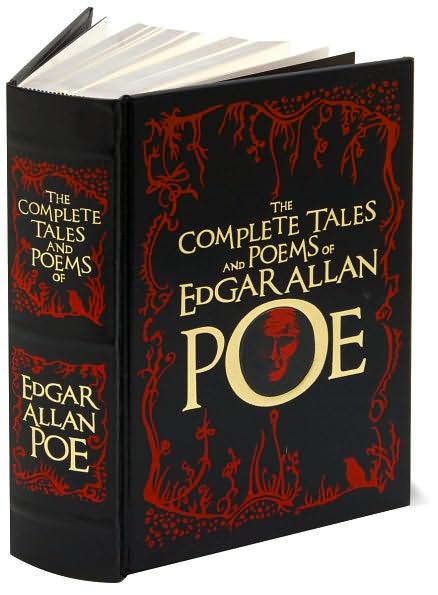
The Complete Tales and Poems of Edgar Allan Poe


The Complete Tales and Poems of Edgar Allan Poe is a collection put together by the company Barnes & Noble Inc. It contains every single piece of literary work that Poe had ever written. Including his only novel, The Narrative of Arthur Gordon Pym of Nantucket, which sadly ended up being one of the worst novels ever published. However, I decided to read several of his poems, all having a related theme: The death of a beautiful girl. I chose the following poems: "The Raven," "Eldorado," "To Helen," "Deep in Earth," "A Valentine," "Annabel Lee," and several other poems. They all hold the central plot of either a beautiful girl dying or the lost of a love one. Sub plots include simple reflection on Romance and the feeling of loneliness. Poe has commonly been looked at as been a Dark Romantic, which is a somewhat accurate description of his writings and beliefs. However, when you deeper into his work, the reader begins to feel sympathy for this man and begins to understand why so much of his work is seen as almost depressing in some cases. The poem "Annabel Lee" is usually connected to the death of his beloved wife, Virginia Clemm, who died while they were young. And "The Raven" talks of a man who has lost the love of his life and feels no need to live a happy life anymore. "A Valentine" is one of his only poems that contains no signs of depression or darkness. It's a simple, yet elegant love poem; possibly for Virginia. It should also be noted that Poe's idle, a mother of a friend, died when he was still in his younger years. This definitely contributed some grief to the hopeless romantic. Overall, his love was anything but amazing. However, the reader must keep in mind that not all great writers come from a great past. If that was the case, there would be nowhere as much amazing literary work than there is today.

1. If the love of your life died, would you be able to accept his/her death? Or would a piece of you feel broken for the rest of your life? Would you be able to fall in love again?

2. What are your views on Poe? Do you like his work? Why do you think his only novel flopped?

3. Would you consider Poe to be an 'old school emo?'

A Clockwork Orange

Anthony Burgess' A Clockwork Orange is a story about a hypothetical future, the likes of which mankind should never hope to see. The book starts off in England, in a little bar in a small city. Here we meet Alex, the protagonist of the story, and his "droogies", or friends as they say in NADSAT, the hip, Slavic rooted lingo of the teens. Alex is the boss of his three friends, a criminal boss, and they are all about to go out on a night of pillaging and ransacking. Throughout the night they commit heinous acts of violence, stealing, and Alex ends up raping a poor woman by the end of the night. After all is said and done there is a small quarrel within the group of "friends" and they decide to call it a night and continue with the shenanigans the next day. The next day, Alex is betrayed by his friends and caught by the police. In jail, the government, in their desperate attempt to quell the unstoppable crime rampant throughout the country, use a corrective behavior technique calle Ludovico's Technique. The technique strips away the ability to choose one's actions freely, instead replacing the violent action with one of benevolence. While in this helpless state, Alex is kidnapped by two police officers, one of which was his old gang rival, and one who was his own friend who betrayed him. They leave him in the country side to fend for himself. Luckily for Alex, there is a small village nearby where he finds a place the stay. This man, F. Alexander, we learn is the husband of the lady Alex rapes at the beginning of the story, we find out that this lady died from the trauma. F. Alexander soon learns of Alex's true identity and decides to use Alex to overthrow the government, driving Alex to kill himself and blame Ludovisco's Technique on his death. His suicide attempt fails, but still raises an uproar throughout society. With this uproar, the government, in an attempt to stay in power, fixes Alex. Alex then goes back to a life of crime, but soon tires from it and realizes that violence is not all there is to life. the book ends with Alex day dreaming about raising a son, the right way.

In the story, Alex is not given the right to choose between right or wrong. Is forcing good onto others a good way to fix violence?

Ludovisco's Technique also stripped Alex from one thing he truly enjoyed in life, Classical music, what would you do if you had something you enjoy stripped form you, and every time you even thought about it you were brought to your knees in pain?